Build AI Drug Discovery Pipelines
Build AI Drug Discovery Pipelines is a practical Manning book on using PyTorch, cheminformatics, and modern ML to solve real pharmaceutical research problems.
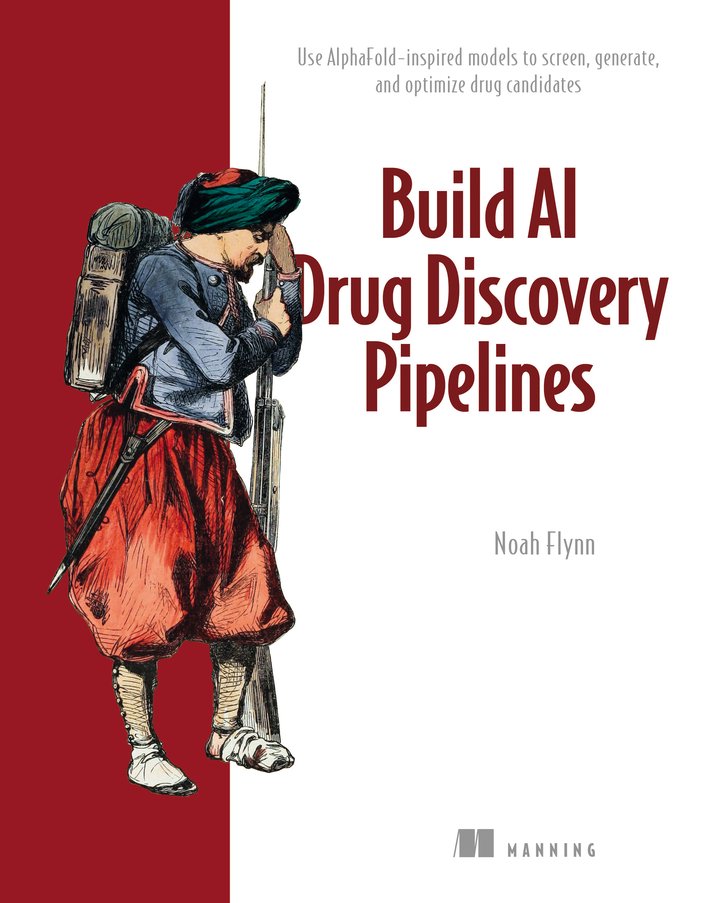
Hands-on deep learning for pharmaceutical research, from molecular fingerprints to AlphaFold.
Status: all chapters are available in Manning MEAP and the manuscript is 100% complete. MEAP v12 shipped in September 2026 with five new appendices; Manning currently lists publication for November 2026.
This book teaches machine learning and deep learning through real drug discovery case studies. Each chapter starts with a concrete pharmaceutical problem--screening antimalarial compounds, predicting cancer drug targets, generating new molecules--then walks through the code and modeling decisions needed to reproduce and extend the work in PyTorch.
No chemistry background is required. If you know Python and basic ML, the book builds the molecular science as you go. If you are a chemist, biologist, or pharmacologist learning ML, the modeling concepts stay anchored in problems you already care about.
Written during my PhD, sharpened while teaching at UC Berkeley, and informed by production AI work at Amazon scale and Google Cloud AI. It is the practical bridge I wanted when I started.
Use code au35fly for 35% off at Manning.
What You'll Build
Practical drug discovery tasks walk readers through screening compounds, predicting ADMET properties, generating molecules, modeling proteins and drug-target interactions, assembling end-to-end AI systems, and more.

Chapters
Part 1: Fundamentals of Cheminformatics & Machine Learning
- The Drug Discovery Process
- Ligand-based Screening: Filtering & Similarity Searching
- Ligand-based Screening: Machine Learning
- Solubility Deep Dive with Linear Models
- Classification: Cytochrome P450 Inhibition
- Case Study: Small Molecule Binding to an RNA Target
- Unsupervised Learning: Repurposing Drugs, Curating Compounds, & Screening Fragments
Part 2: Deep Learning for Molecules & Structural Biology
- Introduction to Deep Learning
- Structure-based Drug Design with Active Learning
- Generative Models for De Novo Design
- Graph Neural Networks for Drug Target Affinity Prediction
- Transformer Architectures for Protein Structure Prediction
- Multimodal AI Systems for End-to-End Drug Discovery Pipelines
Appendixes
- A. Glossary
- B. Chemical Data Repositories
- C. Knowledge Distillation: Shrinking Models for Efficient, Hierarchical Molecular Generation
- D. Technical Deep Dive into Protein Structure Prediction
- E. Extended Technical Material
- F. Chapter References
- G. Chapter Exercises
- H. Computational Drug Target Discovery
- I. Diffusion & Flow Matching with FlowMol3, DiffSBDD, RFdiffusion, & Boltz-2
Testimonials
Early reader notes:
“It’s a compelling blend of machine learning and drug development insights. A must-read for anyone seeking to harness the power of AI in pharmaceutical innovation.”
— Meghal Gandhi, Machine Learning Researcher, Charles R. Drew University of Medicine and Science
“I would recommend this book to my colleagues by emphasizing its practical approach to applying machine learning in drug discovery. I’d highlight how it bridges the gap between technical concepts and real-world applications, making it an essential resource for anyone in healthcare or biotech looking to leverage AI/ML for innovation.”
— Srikanth Daggumalli, Senior Analytics and AI Specialist Solutions Architect, Amazon Web Services
About the Author
Noah Flynn is a Senior Research Scientist at Google Cloud AI, where he works on Gemini Enterprise. Previously, he was an Applied Scientist at AWS Agentic AI and a Research Scientist on Amazon’s Alexa and AGI team, where he contributed to the Amazon Nova model family. He holds a PhD in Computational Biology from Washington University in St. Louis, where his doctoral research focused on modeling drug metabolism and toxicity using graph neural networks.
He has also worked at AbbVie and Merck on applications ranging from gene regulatory network analysis to generative models for compound library design. Noah is an Adjunct Instructor at the University of California, Berkeley, where he teaches graduate courses in machine learning and cheminformatics, and has published over a dozen peer-reviewed papers at the intersection of deep learning and small-molecule drug discovery.
Cite This Book
@book{flynn2025mldd,
  title     = {Build AI Drug Discovery Pipelines},
  author    = {Flynn, Noah},
  isbn      = {9781633437661},
  year      = {2025},
  publisher = {Manning Publications}
}